Back in the day when England was connected to the rest of Europe by land, Southern England was a desert.
This was during the Ice Age, and mankind was just taking his / her / its first steps, competing with woolly mammoths, woolly hippos, woolly rhinoceroses, and woolly sabre-toothed tigers for food and places to live.
OK, maybe not the hippos and tigers, but the other two were there.
Mankind at the time was living in Africa, but were starting to branch out, trying to find warmer places on the planet to live. For now, however, they / we have been written out of this post.
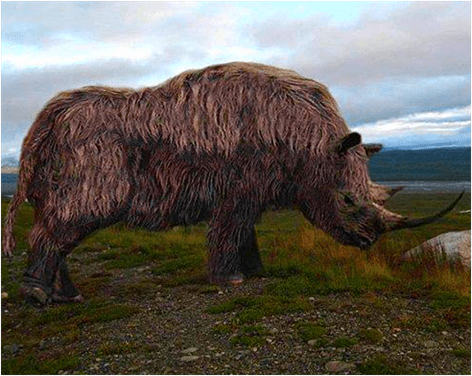
The woolly rhinoceros loved to roam free. It was built for the cold conditions of the time. It had a stocky body, with thick fur and short legs. It was a herbivore, so lived, primarily on salad – actually, grasses.
At the beginning of the Ice Age, the woolly rhinoceros lived in the Himalayas, but migrated to Europe and Asia as time went on.
The average adult woolly rhinoceros was about 6 foot 6 tall, twelve-and-a-half feet long, and weighed in at 7,000 pounds. The creature was very common during the impressive sounding Pleistocene Epoch, which is a geological ‘time period’ that lasted between 2,588,000 to 11,700 years ago, so all in all it was quite recent. And, in case you’re wondering what an epoch is, it’s a timescale longer than an age but shorter than a period. Oh, I hear you say! We are currently living in the Holocene Epoch; ‘Holocene’ comes from the Greek words meaning ‘entirely’ and ‘recent’.
So, the woolly rhinoceros roamed happy and free for thousands of years, but changes over time led to their extinction. There is some debate that mankind (yes, I have written mankind back into the post now!) may have had something to do with the species dying out, due to over-hunting, but a lot of other species became extinct around the same time as the Earth’s temperatures began to rise, so man can’t really be blamed entirely. Can we?
As the Earth warmed up, England and the rest of the UK became separated from the rest of Europe as the sea waters rose, creating a little island off the north-west coast of continental Europe. The desert landscapes of southern England changed to become the green and pleasant land that they are today, hosepipe bans notwithstanding.
Preserved remains of the woolly rhinoceros have been found in the county of Staffordshire, England, and in Poland, and presumably numerous other places as well. In fact, the oldest remains have been recently discovered on the Tibetan Plateau in the Himalayas, and was aged to be about 3.5 million years old.
So, even though they no longer exist today, they had been around for a very long time in the fascinating history of the of our planet Earth.


 The Mansionic Perspective
Would you like to leave a comment?