Yesterday, you may recall (if you called by, that is!) that I’d made a big hoo-hah about the post being written on March 25th.
March 25th has a link to today, April 1st.
But, before I get to the link, I shall write about March 25th itself, or New Year’s Day, as it used to be known.
Yes, you read that correctly! March 25th used to be New Year’s Day. Throughout Europe in the Middle Ages, New Year’s Day was celebrated then; it was moved to January 1st by Pope Gregory sometime in the Sixteenth Century.
Many civilisations celebrated the New Year in the Spring… the ancient Egyptians did with the spring flooding I mentioned the other day.
March 25th is Lady Day, the day of the Feast of the Annunciation, which commemorates the day when the Angel Gabriel visited the Virgin Mary to advise her that she was to be Mother of Jesus Christ. The feast day today tends to move dates so that it doesn’t fall within Easter week, but March 25th is its official date.
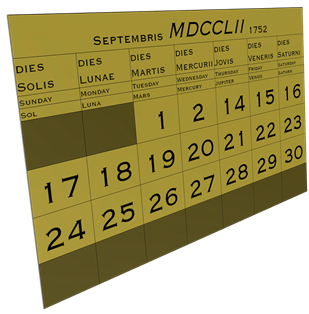 The UK Tax Year also used to begin on March 25th, but in 1751 eleven days had to be removed from the calendar, to bring the UK’s calendar pretty much in line with the rest of Europe and beyond, including the seasons. Back then, the UK government decreed that the day after Wednesday 2nd September 1752 would be Thursday 14th September. The thing is, tax was due for the whole year, so the start date of the tax year was also moved to April 5th to compensate for the tax having to be paid early due to the missing eleven days. Another day was introduced later, but that’s pretty much by the by.
The Feast of the Annunciation’s octave, or eighth day, is April 1st. April 1st is also the date that the early folk used to end their New Year celebrations… or rather, some of them. When New Year’s Day was moved to January 1st, those celebrating New Year on that day would call those who didn’t celebrate that date fools.
There’s always an odd twist or two when it comes to history, isn’t there?
January 1st used to have a feast day all to itself… the Feast of Fools. The day when servants and slaves used to dress up and mock their masters, and generally eat, drink and be merry. This feast day was gradually suppressed, it was so frowned upon.
So, April Fool’s Day now marks the end of a period of time celebrating a New Year, when that time’s fools’ day was our modern New Year’s Day. You couldn’t make it up.


 The Mansionic Perspective
Would you like to leave a comment?