 Crumbling relics
Statues of old
Some made of stone
Others of gold
Show how our ancestors
Viewed their own past
In the hope that some
Of their traditions will last
Now many years later
The relics remain
But are our thoughts behind them
And our ancestors’ the same?
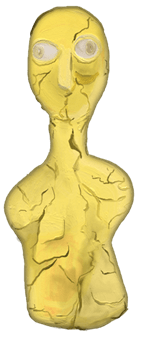
The image above is my interpretation of a figurine from Ain Ghazal, in Jordan. The site is a prehistoric settlement, from the Neolithic period, which dates back beyond 7000 BC. Many of these figurines were created out of plaster and twigs, and not stone or gold as stated in my rhyme.
Several statues were two-headed, which are thought to represent either gods and goddesses, a human couple, or twins. Other one-headed statues still remain, which may have been a representation of ancestors, and there are also statues of animals.
Obviously, being buried for thousands of years has caused some damage to the statues, which were discovered in the 1970s as a road was being built. It’s amazing the things that are still being discovered just beneath the surface.
Last week, a team of metal detector enthusiasts found over five thousand coins which date back to the Eleventh Century, and specifically to the late Anglo-Saxon, early Norman times. The coins feature the heads of Kings Ethelred the Unready and Canute.
Whereas the statues were damaged slightly, considering the amount of time they were buried they were still in mostly good condition, but the coins appear to be in mint condition, as though they hadn’t even been in circulation. Tests are taking place on the coins to see if they are to be classed as treasure.
I live just up the road from Canute’s Ford in Cheshire, or Knutsford as it’s called today, which was so named after Canute apparently built a ford over the as-then treacherous River Lily, so I class that as my connection to this ancient king. There’s always something that links something else, look at the theory of the six degrees of separation.
King Canute is the king who apparently tried to command the waves to turn back; although some accounts of this story show he was merely trying to point out that even he, as great a king as he was, had no control over the elements.
The story highlights the futility of turning back the tide. And if there’s no way back, we can only move forward. But continue to bring the past with us.


 The Mansionic Perspective
Would you like to leave a comment?