Hurtling passed the Earth at an amazing speed is a piece of rock the size of an aircraft carrier. The last time that a meteor came this close to Earth was back in 1976, but apparently astronomers didn’t know about this at the time.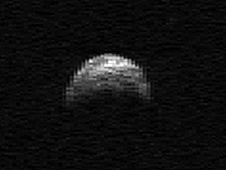
2005 YU55, as it is called, will actually pass closer to the Moon than the Earth, and it is reported that there will be no side effects of the fly-by to the tides or the Earth’s tectonic plates. Although this in itself is good news, when you think about the size of an aircraft carrier on Earth, it makes you wonder (you = me!) exactly what ‘pull’ it will have as it passes by in (nearby) outer space.
However, speaking of tectonic plates causes you (me) to think of the recent news of an unusual earthquake in Oklahoma, which measured a magnitude of 5.6 on 5th November. Latest theories behind this quake, though, seem to be pointing toward the practice of fracking, causing fractures in the Earth’s surface by explosives to obtain oil and gas deposits. We’ve had a couple of earthquakes in the UK as a result of this practice (apparently) so to me it seems we should really be more concerned with what we are doing to our own planet rather than worrying about a ship-sized stone which passes us as it travels on its regular orbit.
The next time YU55 will be close to Earth’s orbit will be in 2041, on November 12th, or thereabouts. Before then, in 2029, the meteor will pass close to one of our neighbouring planets, and astronomers will be watching to see just how close it passes Venus. This will then determine the distance for its fly-by to Earth in 2041.
There are many telescopes and observatories monitoring the meteor’s journey, and one of them, the Herschel Space Observatory, will be looking at the meteor’s temperature and composition in a couple of days time. This observatory is named after the astronomers William and Caroline Herschel who I happened to mention in a recent post, coincidentally.
This is a space phenomenon that I won’t be able to see from my window in Aquatom Mansion, for a number of reasons. The main one is the cloud cover, it’s a bit cloudy out there tonight, and I can’t even see the Moon at the moment. If I can’t see something the size of the Moon, I’m not likely to see something as small as a large ship am I? Secondly, I’d also need quite a good telescope (which I don’t have) or a really good pair of binoculars (and I don’t have any of these either). If I was to rely on my normal vision, and if I could see the object through the clouds, I’d probably end up seeing two of them anyway, as my very long distance vision tends to be slightly doubled. And, cloud cover aside, the photographic facilities on my new mobile phone also wouldn’t pick up this latest cosmic traveller, so there isn’t much point in even thinking of trying to use that.
 Incidentally, today would have been Edmond Halley’s 355th birthday, if he was still around. He was born in 1656, died in 1742, and was the first person to calculate the orbit of another regular visitor our planet has, which we now know as Halley’s Comet. The last time this celestial body called by was back in 1986, and I had better eyesight back then. I am pretty sure that I caught a glimpse of it up in the heavens one day. One day in March, actually. It wasn’t as bright as when it terrified thousands of Europeans back in 1066, but that didn’t matter. It was still a link back to the past and out into the far reaches of space. Halley’s Comet has a pretty unique shape to it, so my ‘pretty sure’ comes with an upgrade to ‘pretty certain’ that I saw it.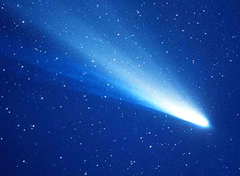
And knowing that I have seen this, possibly the most famous visitor, more than makes up for the fact that I won’t get to see YU55 tonight. But you never know. I may get to see it in 2041. If we get through 2012, that is…


 The Mansionic Perspective
Leave a reply to Tom (Aquatom1968) Cancel reply