More and more symbols are being developed to replAce wordS for certAin things, which in a way is a good thing. The symBOls are easily remembered, and you instantly know what they mean. Look at the symbol for peace, which is used by the peace campaigners; 
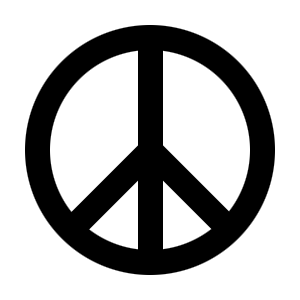 or the recycling arrows. They both VEry clearly diSplay what they mean, because we knOw what they are intended to mean. But who decides on what the symBols should bE? Can we create our own symboLs to be used in every day cOnversations? And hoW do we spread word that the symbol that we have chosen to represent the word (or phrase) means just that?
There’s a phrase that says a picture is worth a thousand words. Imagine creating a symbol that could literally represent that? More importantly, what would your symbol say? What impact would it have on the world? Would it be overused?
Thinking about symbols has got me thinking about hidden messages, and I’ve hidden one in the paragraph above. Not very well, I must admit, and it is actually a phrase I have used very recently. I’ve made the letters stand out, but the message would still be hidden there, and a little less obvious if I’d adjusted the font size slightly on the intended letters. Not so much they are noticeable, but so they would be picked up subconsciously. The mind will see the difference and may well pick up the message. I’ve not hidden any other messages in this post, and the yellow spotted red mini that you are now imagining is not there because of your subconscious!
Look at hieroglyphics… images our ancient ancestors used to depict the events of the day. Some are obvious, and some may have more than one meaning, and depending on how they are interpreted can make all the difference in the meaning of the sentence they are trying to convey. Could they have hidden any messages in their symbols way back when, that we haven’t worked out yet?
It all comes down to interpretation. How we interpret what we see. And what we see may not always be the truth! Now, I know ‘seeing is believing’, and to fully experience it, you have to see it with your own eyes, but is what you are looking at actually what you are seeing? There is a difference between looking and seeing although you are doing both. Look at a railway line and follow the tracks into the distance. Due to perspective, it looks as though the lines meet in the distance. That is what you see. But you know the lines are parallel and they cannot possibly meet all that way up there. They will stay the same distance apart all the way to the end of the line. If you were to see the railway tracks for the very first time (and be totally unaware of perspective) you would see, and interpret, that the lines do actually meet. And if you had to design a symbol to represent what you have seen, you would probably draw a tall narrow triangle to start off with. And someone else looking at a symbol of a tall narrow triangle may interpret it as pointing upwards, rather than into the distance.
It adds a different perspective to the phrase ‘someone’s point of view’, too! Try to see things differently. Be open to receive other interpretations of things. Try to see the fuller picture.
Oh, and by the way, when I mentioned the yellow spotted red mini earlier, what image did you see in your mind’s eye? If you didn’t see an image, that’s fine. Did you see a red car covered in yellow spots? Or was it a girl wearing a short red dress with yellow spots? Or even the word ‘mini’ in a yellow-spotted red font? Or perhaps you saw something else. It doesn’t really matter what it was that you saw this time, but it can matter how you interpret things. It is very easy to jump to the wrong conclusion in things…
I was going to end this post there, but I’ll end it here instead! No reason…
 The Mansionic Perspective
Would you like to leave a comment?